Architectural models take pride of place in our studio. As you enter the space, a whole world of housing flows before you; sets of steel plinths crowned with a variety of projects in plaster, steel, timber and ply, together resembling a 21st-century reimagining of Joseph Michael Gandy’s celebrated and evocative painting, Public and Private Buildings Executed by Sir John Soane (1818).
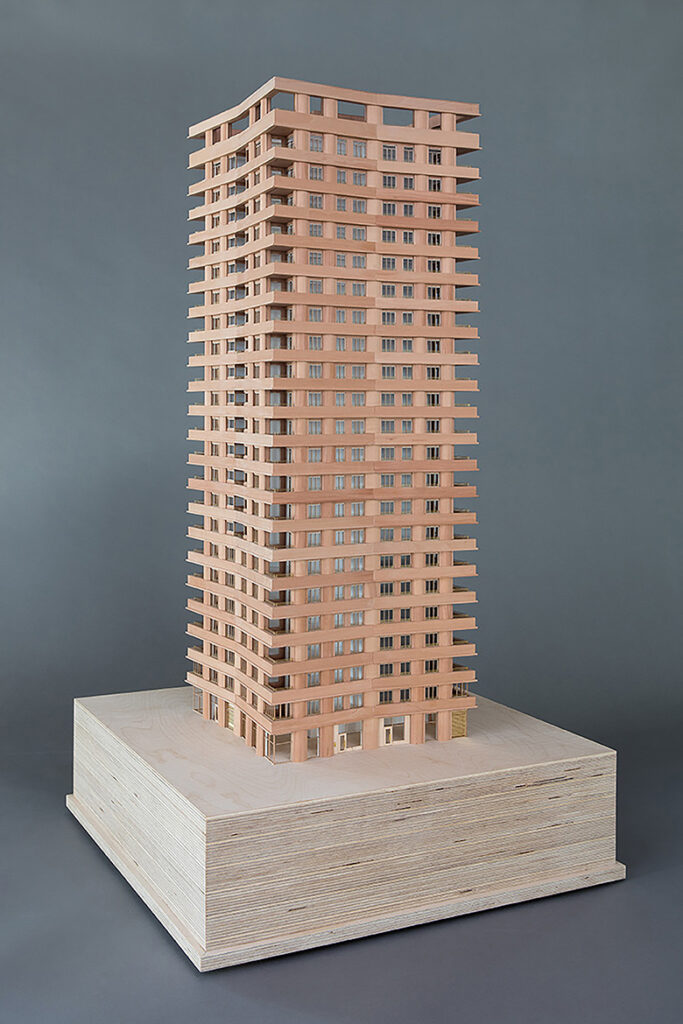
The studio is committed to model making. From project-team discussions, through to public engagement and consultations, and on to competition entries and exhibitions, we create models for everything we do. Each helps to inform the next stage of the design process and, after that entire process is completed, versions of finished projects offer insights for those keen to learn how it was done. For emphatically expressing ideas and engaging others, both within and outside the world of architecture, for most people physical models transcend all other available media, and they remain one of the architect’s greatest assets.
Handcrafted model making, with its beguiling physical processes, is an art form that unites and excites the designer, model maker, residents and clients. The combination of creativity and imagination induces an irresistible sense of power and escapism. For many, the love affair starts as a child. Doll’s houses have been occupying imaginations and thoughts on ideal homes for millennia, while more recently Meccano’s metal strips, nuts and bolts inspired a generation of architects to embrace an engineering aesthetic that became the look and feel of architecture around the world at the dawn of the 21st century. Lego’s plastic miniature bricks with their infinite possibilities are another global infatuation, crossing over from playrooms and living rooms into art galleries and cinemas to provide the basis for entire alternate worlds.
However, models are not just escapist; they are highly didactic and communicative, revealing structural logic, activity and programme. In the 15th century, celebrated Renaissance architect Filippo Brunelleschi built various timber models, some up to a metre high, for the Cathedral of Santa Maria del Fiore in Florence. These models, while widely admired today for their artistic and sculptural beauty, were used to communicate requirements to construction workers on site, who studied them daily to understand how this radical building would be built and what they needed to do in response.
Models in the Process
One of the greatest assets of the three-dimensional model is its ability to break down professional barriers. Given a few moments to orientate, everyone can read, access and enjoy a model, getting down to eye level to imagine themselves on a street or inside a living room; or standing to get a bird’s-eye view of an entire neighbourhood. During the development of the St Raphael’s Estate masterplan, models were used extensively as a first-step tool for residents to co-design the layout of their new estate with us. Using simple, colourful, foam-cut massing models and an extensive site plan at 1:1000 scale, residents were able to understand the relationship between existing buildings on the estate and the new proposals in an enthralling way. With its lightweight and non-precious materials, the model allowed people to quickly lift off pieces, cut and trim them and abstract it to articulate their own suggestions and preferences in the landscape, creating instant proposals for the future of their area.

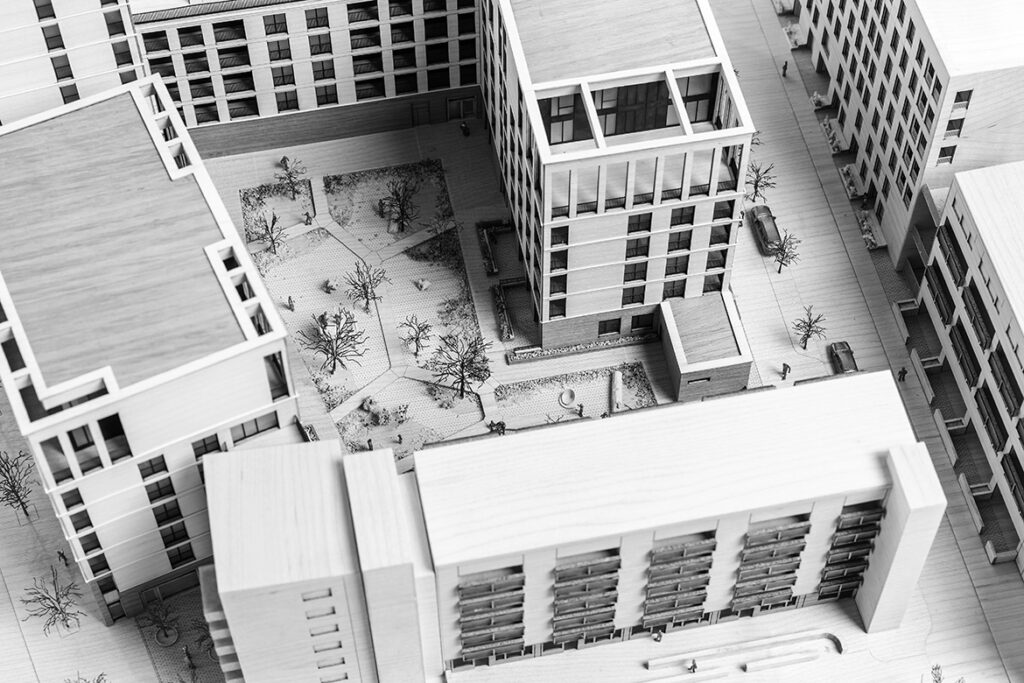
In later phases of the design process, models in the studio are often built to communicate, building form, design quality and detail. Zooming in to 1:250, the model for Kings Crescent Estate Phases 1 and 2 was produced out of fine laser-cut birch and maple veneers. The material quality and craft of the model helped to communicate the final building design and masterplan to the council and residents in an engaging and warm resident friendly manner. Animated public realm, streetscapes and play areas with figures added a light-hearted and instantly recognisable human scale to proposals, tacitly conveying the building design and its relation to the wider masterplan and its adjacent streets.
Within the studio, model making is also a key design tool. Prototyping massing options out of simple blocks of foam and timber in scales from 1:1000 to 1:250 is a quick way in which to understand the spatial conditions of the site and proposed interventions. This speedy process is often used to initiate projects, providing the central focus for hands-on team discussions and design charettes where building blocks may be cut, chamfered, modified or replaced in seconds using an electric hot-wire cutter, evolving concepts, testing ideas and enabling debate.
Moving on to developing the design in detail, laser-cutting paper samples or light balsa wood is often the first step in an iterative process of examining massing and form, materiality, texture and facade handling in 3D, and exploring details such as fenestrations across a facade. Layering laser-cut and etched MDF with brass elements to replicate construction layers and communicate material tones elevates the model’s intricacy. Casting in various materials such as acrylic Jesmonite, concrete, plaster or resin is another technique employed to give a monolithic and tectonic aesthetic to work. Combined, the model maker can blend a host of techniques and materials to produce pieces of beauty and tactility while furthering the design with each step.
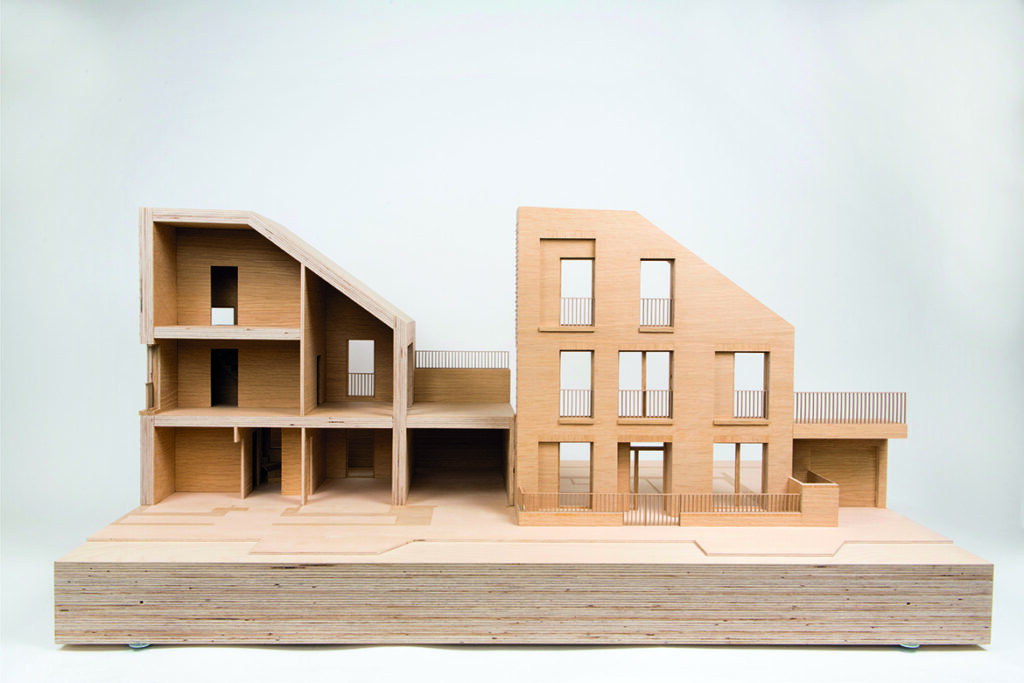
As a studio with a focus on housing, communicating the internal logic of a building or dwelling is key. In this instance, large 1:50 or 1:25 models are created, which means that people can get up close and start to understand living spaces and circulation. Borrowing from the purpose and style of the exploded axonometric or sectional drawing, the cutaway model can further an understanding of structure and communicate multiple issues and perspectives, enabling viewers to see, for example, the relationship between an undulating elevation the balcony or winter garden and the dwelling behind.
Model Endurance
In 2017, the architectural historian and critic Mario Carpo proclaimed the ‘end of the projected image’ in his book The Second Digital Turn. In this exposition of ideas, Carpo discusses the ability of 3D computer-aided design (CAD) software to automatically produce accurate perspectival and parallel images on demand, and thus render the skills of the hand-drafter obsolete. Despite major advances in technology, the appeal and the importance of hand-drawn images are still with us. Similarly, the emergence of augmented reality (AR) and of technologies enabling 3D projection is unlikely to eradicate model making by hand, as was once prophesied. But model making is not without its costs and risks.
The captivating ability of a model remains invaluable. Physical objects possess qualities that cannot be replicated by the digital. It is hard to pore over or fall in love with a digital flythrough or an app. An object that provokes the enquiry, the imagination and the escapism of childhood will be very hard to replace. A handmade object communicates craft, tactility, warmth and texture, human qualities that provoke debate and joy. As a studio with a close relationship to communities through a set of public and community led projects, such interpersonal attributes and objects that provide rich stimuli are understandably valued and will have a long future in our studio culture. Long live the model!
This essay is from Public Housing Works, Lund Humphries, 2021.